Every year salaried people face the same question: old regime or new regime? The answer depends on your income and, above all, on how much you can legitimately deduct. Guessing is expensive, and the maths is not hard once someone lays it out.
The free Income Tax Calculator on EverythingTool compares both regimes side by side for FY 2026-27 (AY 2027-28) for resident individuals and tells you which one costs less. Here is how it works and how to read the result.
The two regimes at a glance
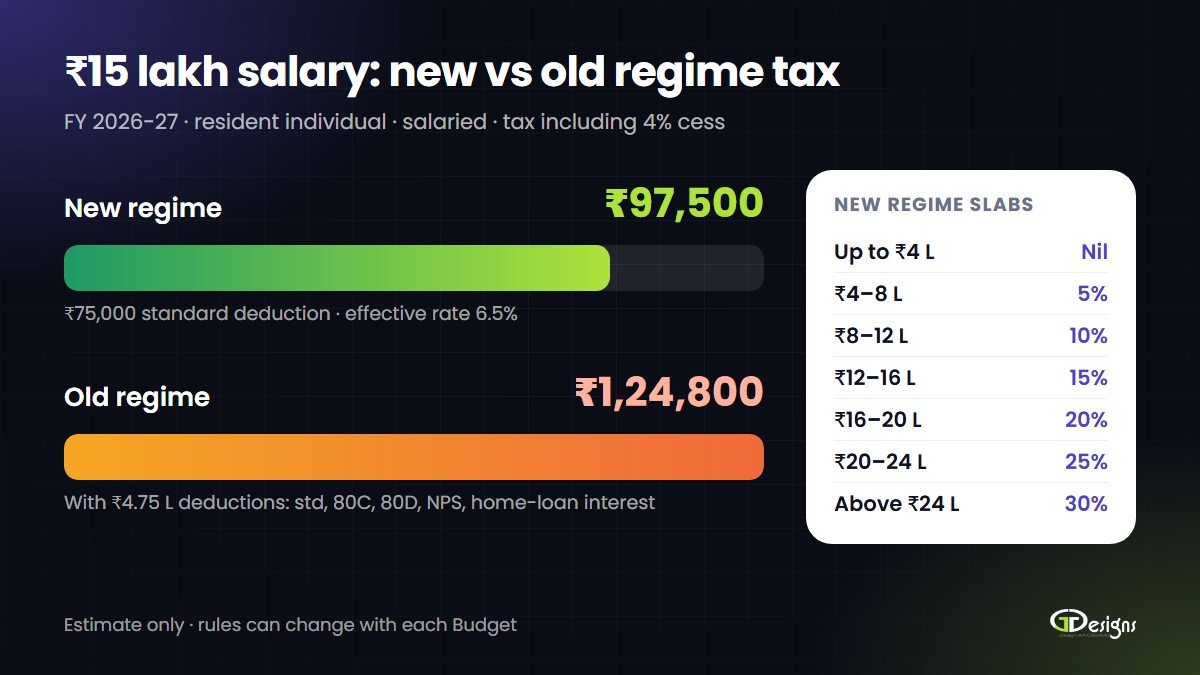
New regime (the default). Lower rates and almost no deductions. The slabs used by the calculator are:
- Up to ₹4 lakh: nil
- ₹4 to 8 lakh: 5%
- ₹8 to 12 lakh: 10%
- ₹12 to 16 lakh: 15%
- ₹16 to 20 lakh: 20%
- ₹20 to 24 lakh: 25%
- Above ₹24 lakh: 30%
Salaried taxpayers get a ₹75,000 standard deduction, and the Section 87A rebate makes tax nil if taxable income is up to ₹12 lakh. In practice, a salaried person earning up to ₹12.75 lakh pays no income tax in this regime.
Old regime. Higher rates, but you can claim deductions and exemptions such as HRA, Section 80C (up to ₹1.5 lakh), 80D health insurance, home-loan interest under 24(b) (up to ₹2 lakh) and NPS under 80CCD(1B) (up to ₹50,000). The standard deduction is ₹50,000, and the basic exemption is ₹2.5 lakh for those below 60.
What you enter
- Gross annual salary, plus other income taxed at slab rates such as interest, rent or freelance income.
- Your age group: below 60, 60 to 79, or 80 and above.
- Employer NPS contribution under 80CCD(2), which is allowed in both regimes.
- For the old regime only: HRA exemption, 80C, 80D, home-loan interest, your own NPS, professional tax and other deductions like 80E, 80G and 80TTA.
What you get
For each regime the calculator lists gross income, standard deduction, other deductions, taxable income, tax on slabs, rebate or marginal relief, surcharge, the 4% health and education cess, and your effective tax rate. At the top it recommends a regime and shows how much you save by choosing it.
A worked example: ₹15 lakh salary
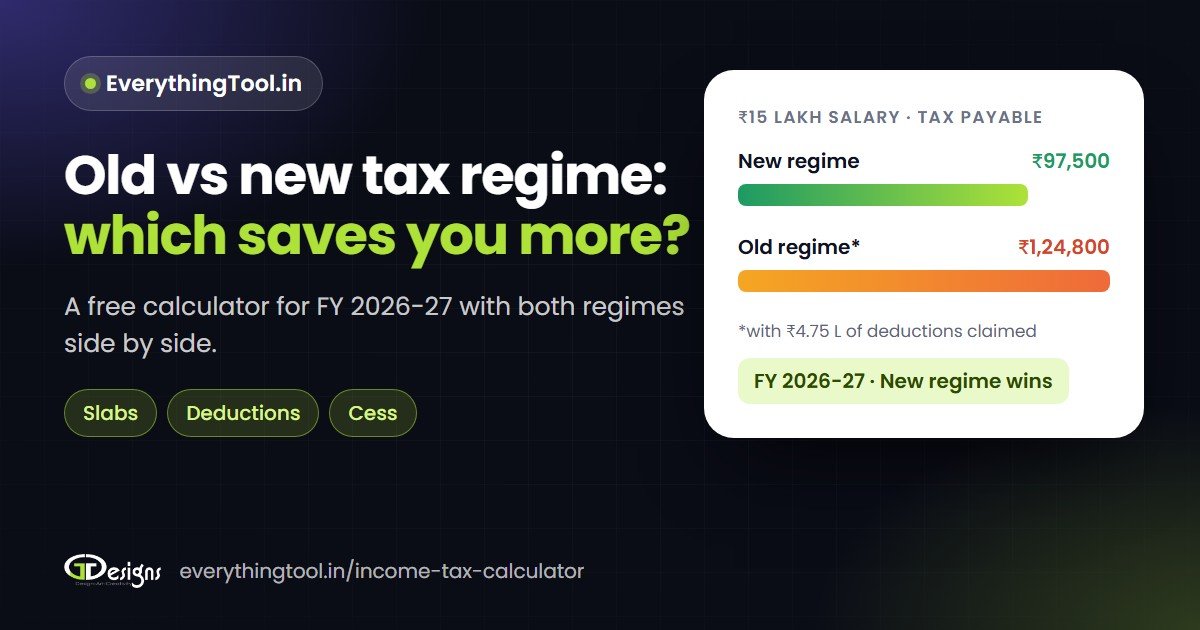
For a salaried person with ₹15 lakh gross, the calculator shows new-regime tax of ₹97,500, an effective rate of 6.5%.
Now suppose the same person uses the old regime and claims a generous set of deductions: ₹50,000 standard deduction, ₹1.5 lakh under 80C, ₹25,000 for health insurance, ₹50,000 for their own NPS and ₹2 lakh of home-loan interest. That is ₹4.75 lakh in total, bringing taxable income down to ₹10.25 lakh. The old-regime tax comes to about ₹1,24,800, still higher than the new regime. Many people assume deductions of this size make the old regime the winner. At this income, they do not.
When the old regime still wins
The old regime tends to win only when your total deductions are large, often ₹4 lakh or more for middle incomes, and usually more as your income rises. It is worth a close look if you:
- pay significant HRA-eligible rent in a high-rent city,
- have a home loan with substantial interest,
- invest the full amount under 80C and also use 80D and NPS.
The best way to know is to enter your real numbers rather than rely on a rule of thumb.
Things to remember
- Salaried employees can change regime each year when filing. Business income earners have stricter rules about switching, so check with your CA.
- Capital gains and other special-rate income are not part of this calculator.
- Surcharge applies at higher incomes (above ₹50 lakh), with marginal relief at the thresholds, and cess of 4% is added to the tax.
- Tax rules can change with every Union Budget. This tool is for estimation, and it does not replace advice from a Chartered Accountant or the Income Tax Department.
Do the comparison before you declare
Run your numbers before you submit investment proofs to your employer and again before you file your return. It takes about a minute, it is free, and you can copy the result or share it. Open the Income Tax Calculator, or explore the full set of free calculators at EverythingTool.in.