A home loan is usually the biggest financial commitment a family makes, yet most people judge it by one number: the monthly EMI. The EMI tells you whether you can afford this month's payment. It does not tell you what the loan will cost you over twenty years, and that second number is the one that should shape your decision.
The free EMI Calculator on EverythingTool shows both in seconds. Here is how to use it to compare loans properly before you sign.
What you enter, and what you get
Pick a loan type (home, car or personal) to load sensible starting values, then enter the loan amount, the annual interest rate and the tenure in years. Results update instantly as you change any of them. You see:
- Monthly EMI, the amount that leaves your account every month.
- Total interest, the extra you pay the lender over the full tenure.
- Total payment, principal plus interest.
- The principal-versus-interest split, so you can see how much of what you pay is actually repaying the loan.
- A year-wise schedule with principal paid, interest paid and the balance remaining at the end of each year.
An example: ₹50 lakh at 8.5%
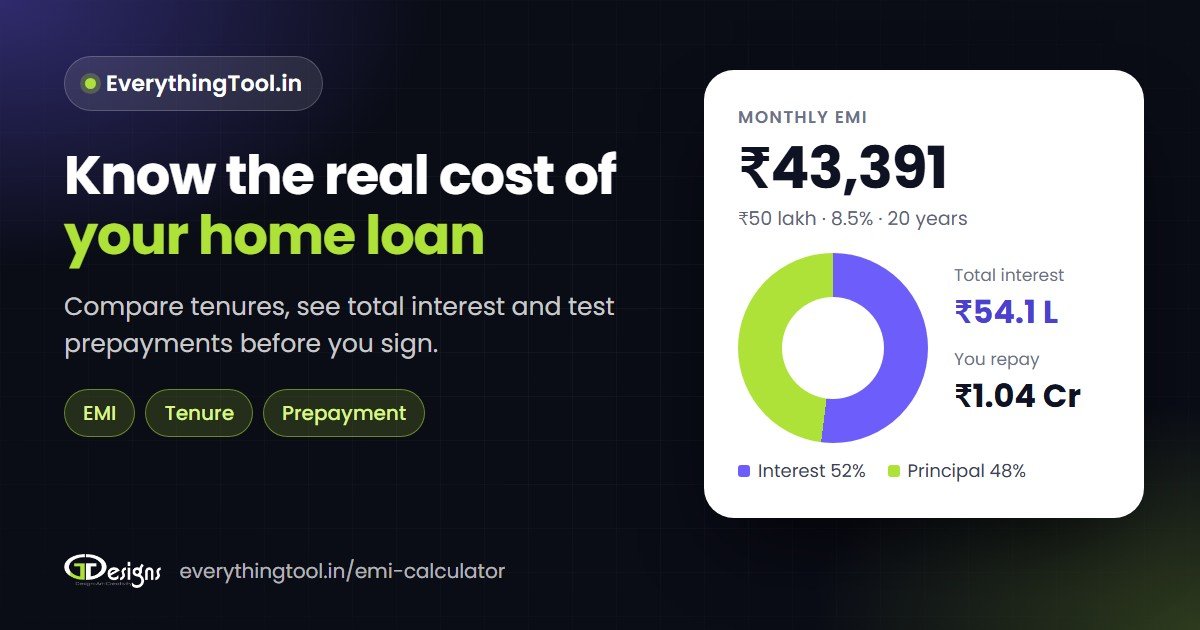
Take a ₹50 lakh home loan at 8.5% a year over 20 years. The calculator gives an EMI of about ₹43,391 and total interest of about ₹54.1 lakh. In other words, you repay more than ₹1.04 crore to borrow ₹50 lakh. Most buyers are surprised by that figure, and seeing it before you sign is the whole point.
Tenure: the biggest lever you control
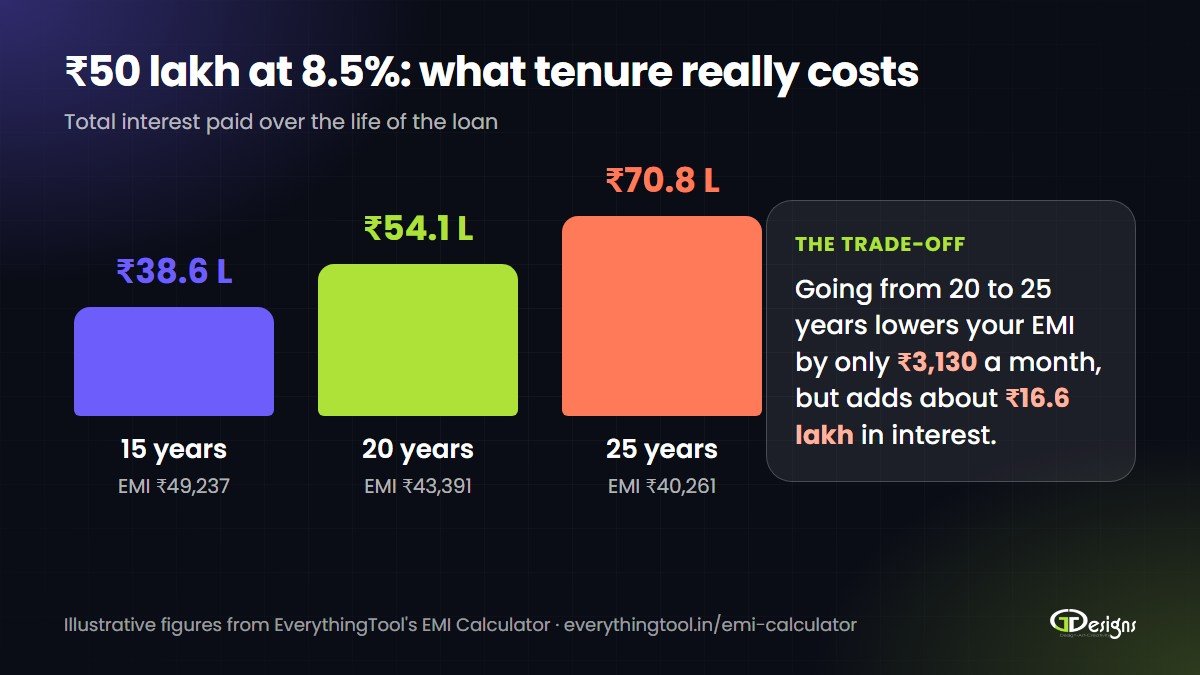
Run the same loan at three tenures and the trade-off becomes clear:
- 15 years: EMI about ₹49,237, total interest about ₹38.6 lakh.
- 20 years: EMI about ₹43,391, total interest about ₹54.1 lakh.
- 25 years: EMI about ₹40,261, total interest about ₹70.8 lakh.
Stretching from 20 to 25 years lowers your EMI by only about ₹3,100 a month, but adds roughly ₹16.6 lakh in interest. A good rule is to choose the shortest tenure whose EMI you can pay comfortably, with room left for emergencies and other goals.
How much EMI is too much?
Lenders commonly allow total EMIs of around 40 to 50 percent of your net monthly income, but that is the lender's limit, not a comfortable one. Many planners suggest keeping all EMIs together under 30 to 35 percent of take-home pay. Add up your existing EMIs, include the new one, and check the total against your income before you commit.
Part-prepayments: where you save real money
The calculator lets you add a one-time lump sum or a regular extra payment, and choose whether it should reduce your tenure or your EMI. Two examples on the same ₹50 lakh, 8.5%, 20-year loan:
- A one-time ₹5 lakh prepayment after three years, keeping the EMI unchanged, ends the loan about 41 months early and saves roughly ₹17.8 lakh in interest.
- An extra ₹5,000 every month from day one shortens the loan by around 4 years and saves roughly ₹13.6 lakh.
Reducing the tenure saves more interest than reducing the EMI. Choose a lower EMI only if you need the monthly breathing room. These are estimates from the calculator's formula; your lender's exact figures can differ slightly because of how and when they apply payments.
What the calculator does not include
The tool shows principal and interest only. Processing fees, insurance, GST and prepayment charges are not included, so ask your lender for those separately and add them to your real cost. Also confirm whether your loan has a floating rate: if the rate changes, your EMI or tenure will change with it, so re-run the numbers when it does.
A quick checklist before you sign
- Enter the offered amount, rate and tenure, and note the total interest.
- Try one shorter tenure and see what the EMI becomes.
- Check that all EMIs together stay within your comfort limit.
- Model a prepayment you could realistically make every year.
- Ask the lender about fees and prepayment charges.
It is free, needs no sign-up, and you can copy the result or share a link on WhatsApp to discuss it with your family. Try the EMI Calculator, or browse all the tools at EverythingTool.in.