A booking enquiry arrives on WhatsApp. The quotation is in a Word file. The contract is in someone's email. The run sheet is in a shared drive, and the invoice is in an accounting tool. By the time the show happens, five people each hold a different version of the truth, and a double booking or a missed payment is only a matter of time.
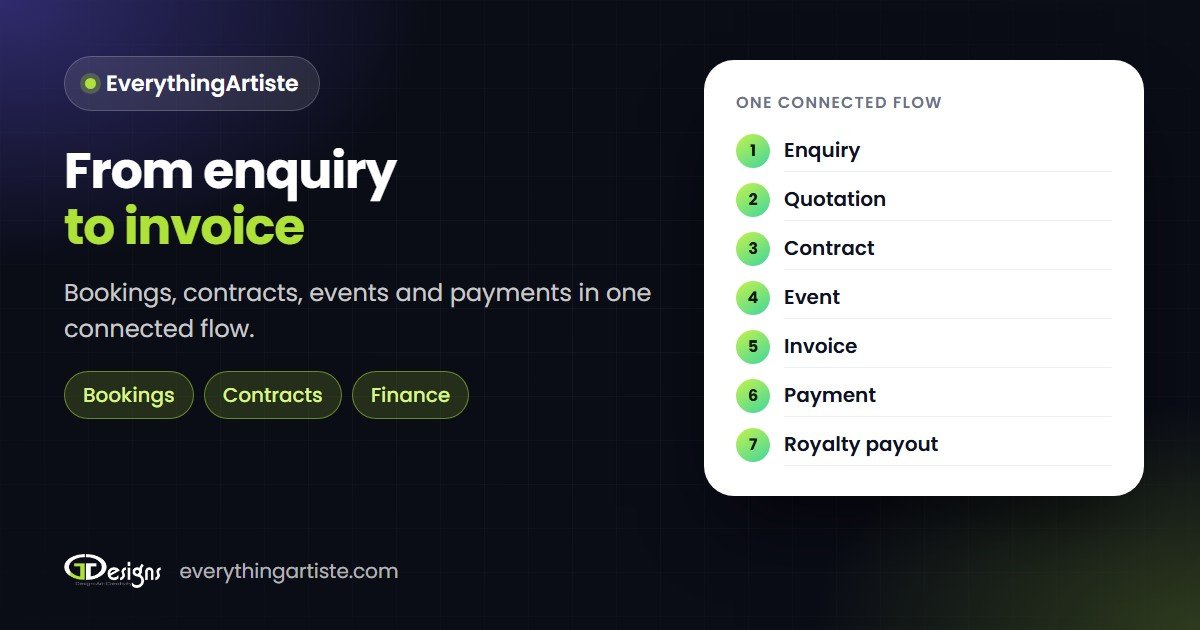
Talent and artiste management works best as one connected flow, where each step feeds the next. Here is what that flow looks like and what to check at every stage.
1. Enquiry: capture it properly
Every enquiry should become a lead with the client's details, the date, the venue and the artiste they want. A pipeline with follow-up reminders stops promising enquiries from going quiet because nobody replied.
2. Quotation: be fast, and avoid double booking
A quotation should be quick to produce and version-controlled, so you always know which price the client saw. Before you send one, check the artiste's calendar. Double bookings are costly, and good scheduling allows for buffers and travel time between shows, not just the show itself.
3. Contract: terms in writing, with history
- Use templates with merge fields so every contract starts from approved wording.
- Keep version history and a review and approval step.
- Record signatures for each party and keep the signed copy with the booking.
- Track obligations and expiry dates with reminders, so nothing lapses unnoticed.
4. Event: everyone knows the plan
For the event itself you need the technical rider, checklists, a printable run sheet and a shared calendar. Multi-artiste events add complexity, so each artiste's schedule should come from one source, not separate messages.
5. Invoice and payment: no manual re-typing
The invoice should come from the booking, not be typed again. That means correct amounts and the right tax treatment. If you invoice clients in other countries, you may need VAT or sales tax instead of GST, in the client's currency. Online payment from a client portal speeds up collection.
6. Artiste payout and royalties: close the loop
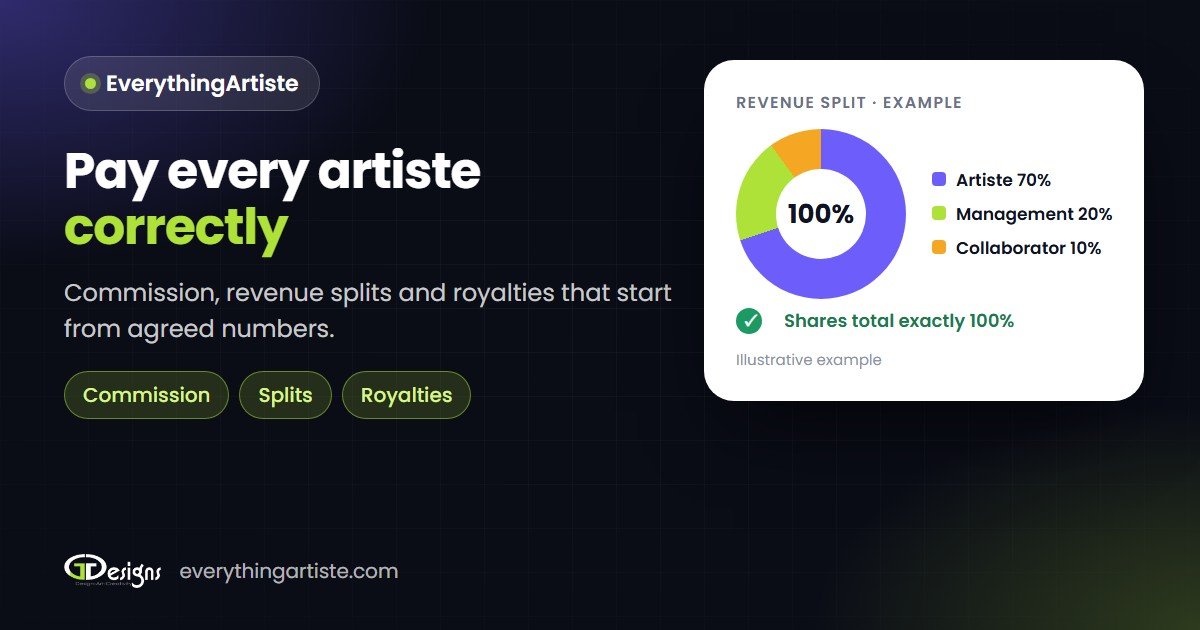
Once the money is in, the artiste's share, after commission and any agreed splits, should be calculated from the same record and paid with a clear statement.
How EverythingArtiste connects it
EverythingArtiste follows exactly this chain: artiste and team, enquiry, quotation, contract, event, invoice, payment and royalty payout. Specifically:
- CRM and leads: clients, contacts, tax details and a configurable lead pipeline with follow-up reminders.
- Bookings and quotations: an enquiry-to-settlement workflow with versioned PDF quotations and automatic double-booking prevention that respects buffers and travel time.
- Contracts and signatures: templates with merge fields, version history, review and approval, signatures recorded per party, signed copies, obligations and expiry reminders.
- Events, run sheets and calendar: multi-artiste events, technical riders, checklists, printable run sheets and shared artiste calendars.
- Finance and tax: tax invoices and credit notes, payments, bills and expenses, artiste payouts and period close.
- Portals: clients can pay online through Razorpay once you add your Razorpay keys, and artistes can see their own schedule.
- Roles and access: an artist manager sees only the artistes they are assigned to.
Note that a dedicated e-signature provider and WhatsApp, SMS and push alerts are listed as still to come, so signatures are recorded in the system today rather than sent through an e-sign service.
A quick audit of your own flow
- Is every enquiry recorded in one place, with a follow-up date?
- Do you check the calendar, including travel time, before quoting?
- Can you see which version of a quotation the client received?
- Are contracts built from approved templates, with expiry reminders?
- Does everyone involved see the same event plan?
- Is the invoice generated from the booking?
- Is the artiste's payout calculated from the same record?
If several answers are "no", you are probably losing time and money between steps. Explore EverythingArtiste or ask us for a walkthrough.